 |
|||||||||||||||
|














|
|
 |
|
|
|
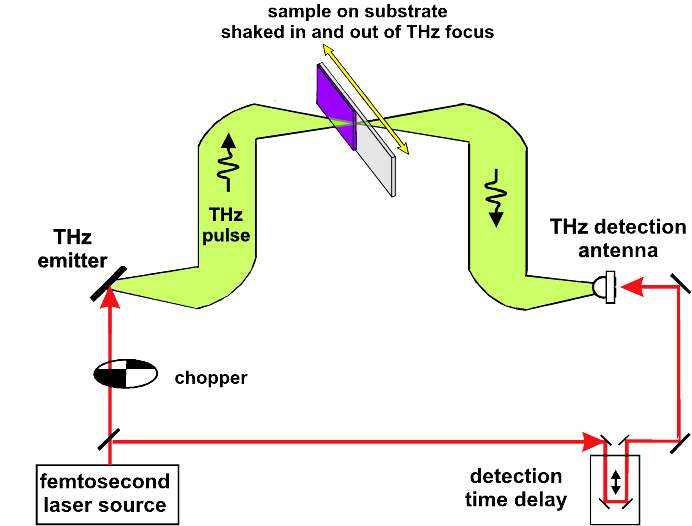
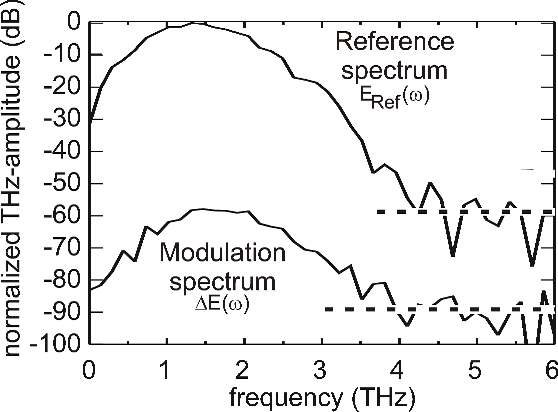
Time-domain THz-spectroscopy has already shown its huge potential for analysis of materials relevant for industrial applications, solid state science, chemistry and biotechnology. In many cases it is very appealing to use the impressive bandwidth of this technique for the characterization of very thin layered systems, like dielectric films for high-frequency devices, the analysis of nano structured materials or the small material quantity in biomolecular analyses. However the analysis of thin layers can be extremely demanding in terms of signal resolution due to the small interaction length of a transmitted THz pulse and the material to be analyzed which results in minimal modifications of the THz pulse. Inherent system fluctuations can make it impossible to characterize thin layered films. The traditional approach to characterize the electromagnetic properties of a sample with TDSL consists of two consecutively performed measurements. The first one is needed as reference to account for the system answer and also for the properties of a substrate on which a thin film is deposed. This approach involves a double modulation technique to drastically enhance the sensitivity. Additionally to the modulation of the THz beam with a chopper, a shaker is used to periodically move the sample and the reference in the focus of the THz beam. By this means the influence of the inherent system fluctuations can successfully be suppressed. In this work the sensitivity of a time domain THz transmission setup could be enhanced from 60dB to over 90dB enabling the determination of the refractive index of SiO2 of only 100nm
Fig 2: Left: Refractive index of a 100nm thin SiO2 film. Right: Comparison of reference and modulation spectra. More information on this work:
|
 thickness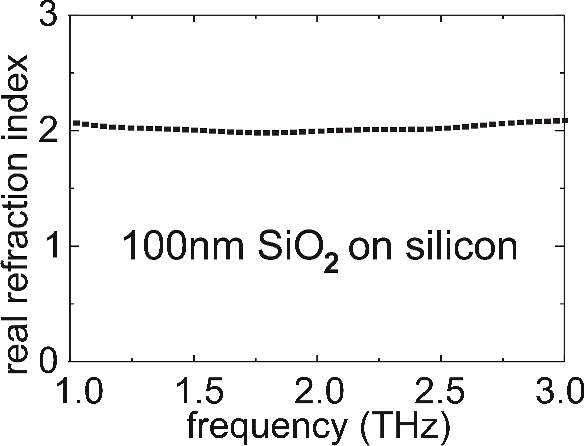
|
|
|
[Martin Brucherseifer] [About me] [Resume] [SEM / FIB] [Scanning Probe Microscopy] [THz Spectroscopy] [DNA Analysis] [THz Modulation] [THz Tomography] [Optical Pump - THz Probe] [AIXScan] [Publications] [Links] [Disclaimer] |