|
One of the prominent challenges of biotechnology is the development of simple and flexible systems for the rapid analysis of genetic material. These are important for widespread applications in medicine and biology like, e.g., the detection of changes in the DNA encoded chain in patient’s blood for the early diagnosis of diseases or gene therapy or the detection of specific signatures of viruses and bacteria.
The essential procedure of detecting specific DNA sequences is based on a simple principle. DNA chains consist only out of four different components, which themselves can only bind in pairs respectively. Thereby two single chains can only bind together, if their components sequence is exactly complementary. specific DNA sequences is based on a simple principle. DNA chains consist only out of four different components, which themselves can only bind in pairs respectively. Thereby two single chains can only bind together, if their components sequence is exactly complementary.
When separating (denaturing) this bound DNA (patient DNA) and combing it with a synthesized sequence (probe DNA) these can only bind (hybridize) if the complementary sequence of the probe DNA is part of the patient DNA. For conventional means the probe DNA sequences are placed on determined positions of a "Biochip". By labeling the patient DNA with e.g. fluorescent molecules it can be detected afterwards. But this means an additional preparatory step, which furthermore induces uncertainties in the analysis.
Therefore there is a great effort, to evolve new technique, that can probe this hybridization state without the need of additional marker labels. Several calculations showed, that a multitude of resonances (base twisting, helix, ...) in a DNA system that depend on the binding state (denatured - hybridized) are within the THz frequency range. Although these calculations are not precise, because the assumed interactions are not exactly known, they already allude the high potential of THz spectroscopy for analysis of the DNA binding state.
Our first experiment demonstrates, that it is indeed possible to distinguish two DNA samples consisting of the same source material but once being hybridized and once being denatured. They were dropped onto a sapphire substrate, dried and subsequently analyzed by time domain THz spectroscopy. As a result, it can be seen, that the time delay of a THz pulse through the hybridized sample is bigger than through the denatured sample. Described as refractive index (Fig. 2) this is a higher value for the hybridized sample over a broadband frequency range. The sensitivity of this experiment cannot compete with conventional methods. It can rather be seen as a proof of principle, that the binding state of DNA can be probe by THz spectroscopy without any further marker labels.
New approaches developed in the group of Peter G. Haring Boliver to increase the sensitivity of this method, based on wave-guide devices including resonator structures already demonstrated the detection level in the femtomol range.
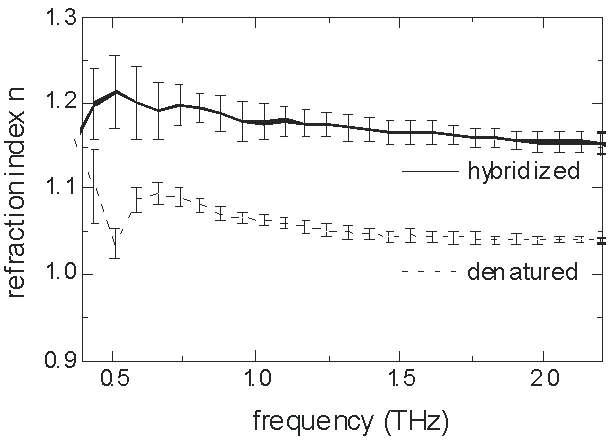 |
Fig. 2: Refraction index plotted over frequency for hybridized and denatured sample.
More information on this work:
Gendefekte präzise aufgespürt
M. Lindinger, Frankfurter Allgemeine Zeitung, No. 42, 19. Feb. 2002 (pdf-version)
|















