|
Superconductors, first discovered in 1904 by Kamerlingh Omnes have the unique property, that their electrical resistance drops to almost zero below a specific critical temperatu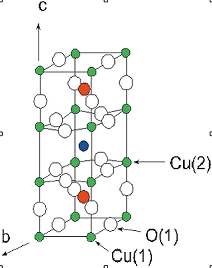 re TC. In 1957 Bardeen, Cooper and Schriefer published their BCS-Theory which could describe this effect up to temperatures of 33 K (-243 °C). But in 1986 a new type of superconductors, so called High Temperature Superconductors (HTSC) were discovered that showed this effect up to temperatures of 133 K (-143 °C). Their superconducting mechanisms could not anymore be described by the BCS Theory and still these materials are not fully understood to date. re TC. In 1957 Bardeen, Cooper and Schriefer published their BCS-Theory which could describe this effect up to temperatures of 33 K (-243 °C). But in 1986 a new type of superconductors, so called High Temperature Superconductors (HTSC) were discovered that showed this effect up to temperatures of 133 K (-143 °C). Their superconducting mechanisms could not anymore be described by the BCS Theory and still these materials are not fully understood to date.
In many experiments THz spectroscopy has
|
Lattice structure of the HTSC YB2C3O7-d
|
already shown its potential to characterize charge carriers in semiconductors or superconductors in a thermodynamical equilibrium by determining its complex refractive index. Here a modified THz transmission setup is used to induce a non-equilibrium state in a HTSC (YB2C3O7-d) by an additional ultra short optical pump pulse with a separated time delay and probe the induced dynamics by the time resolved analysis of a transmitted THz pulse. Due to a high sensitivity of the setup (similar as in THz Modulation) the dynamic of a very low optical excitation density (<4.5 · 1017cm-3) can still be measured.
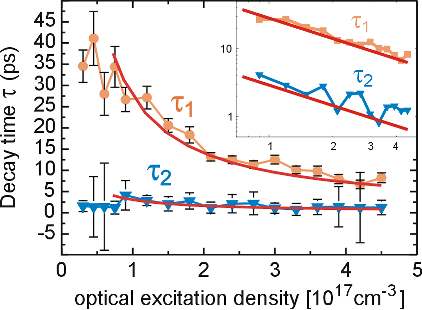
These experiments demonstrate for the first time these two different relaxation components observed by THz transmission spectroscopy. Fig. 2 shows the decay times of both components depending on the respective optical excitation density. Both components have a similar exponential decrease for increasing density.
The presence of two markedly different relaxation components proofs that the simple assumption of a single type of excitations is clearly not sufficient to explain the observed dynamics.
Fig 2: Decay times of two different relaxation components in a YB2C3O7-d sample depending on the optical excitation density can be observed. The inset shows the same data together with a linear fitting curve in a double logarithmic plot.
More information on this work:
Low-density optical pump – THz probe analysis of high-temperature superconductors
M. Brucherseifer et. al., Thirteenth International Conference on Ultra fast Phenomena, Technical Digest. Postconference Edition. Vancouver, BC, Canada: (Opt. Soc. America, Washington, DC, USA), p.301-3 (2002). (pdf-version)
|